 Anna Nuzhna
How stress affects the body: signs without panic
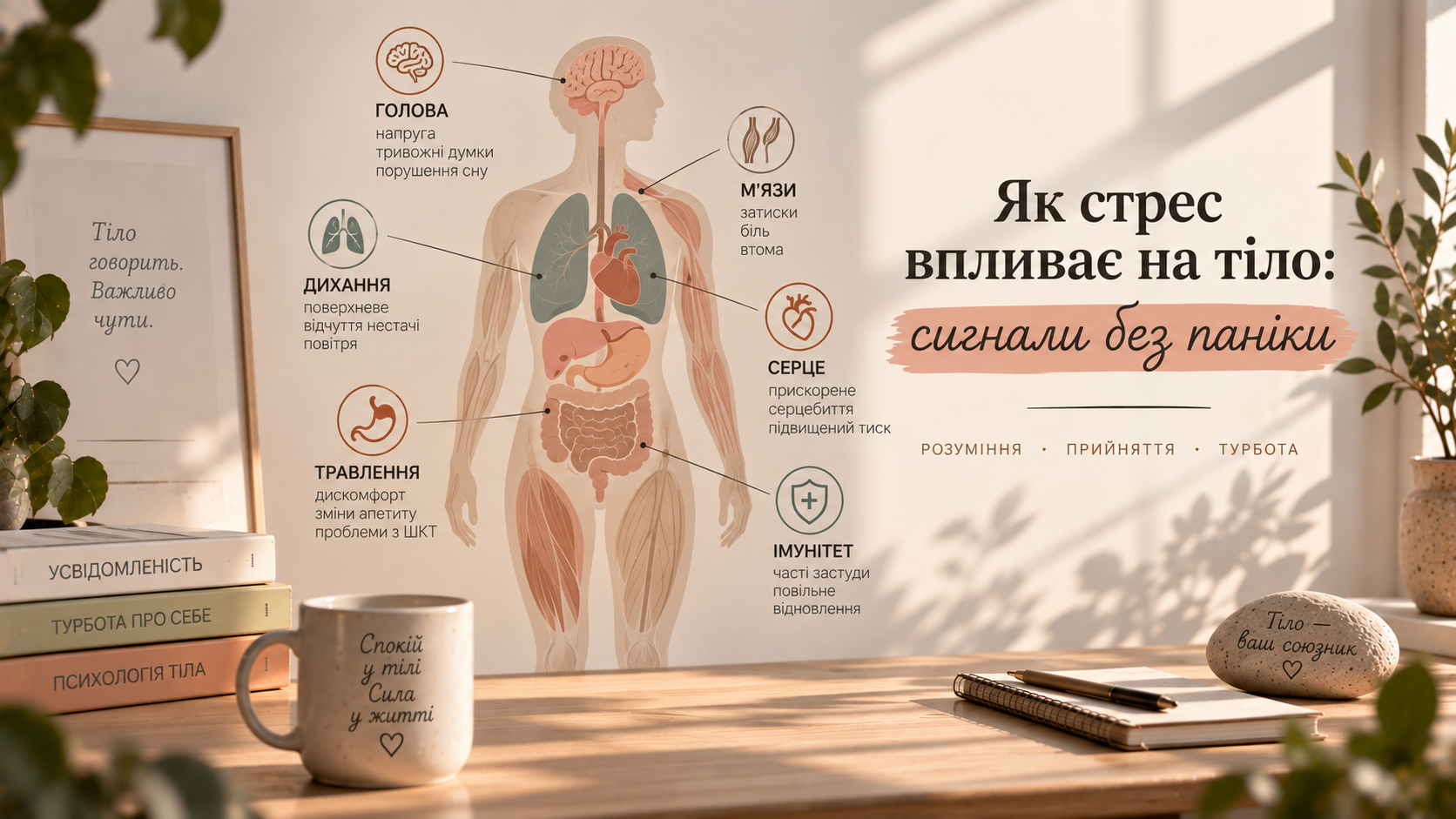
How stress affects the body
Your jaw is clenched, your chest feels heavy, your stomach is turning, and sleep does not come, even though the day has been over for hours. “I’m just working a lot,” you may think, “nothing special happened.” The body seems to disagree.
In my practice, I often notice that clients do not come in saying, “I have stress.” They say, “I’m tired all the time,” “I can’t relax my shoulders,” “I wake up at five in the morning,” or “everything seems normal, but my body is living in siren mode.” And little by little, it becomes visible that the body has been holding tension for a long time — tension the psyche has learned not to notice.
This article does not replace medical advice or therapy. If body symptoms are new, intense, frightening, or interfere with daily life, it is worth contacting your family doctor or a relevant medical specialist. A psychological perspective, meanwhile, can help you understand what the body may be trying to communicate and how to stop treating it as an enemy.
The body is not “breaking”; it is responding to threat
When we experience stress, the nervous system evaluates the situation as potentially dangerous. This does not always mean an actual threat to life. It may be a deadline, conflict in a couple, financial uncertainty, long silence from someone close, relocation, war, the news, or responsibility for children or parents.
The body turns on a mobilisation mode. The heart beats faster, breathing becomes shallower, muscles tighten, and attention narrows. In a short-term situation, this can help: to gather yourself, act, or get through a difficult conversation. Problems begin when the “hold on” mode becomes the background for weeks or months.
Then the body keeps pressing the accelerator, even though the car has been parked for a long time. A person goes to bed, but their shoulders remain lifted. They watch a series, but their jaw stays clenched. They say, “I’m calm,” while their stomach tightens before every message in a work chat.
I find the transactional analysis idea of ego states very useful here. Under stress, the inner Critical Parent often becomes active: “Don’t fall apart,” “Pull yourself together,” “You have to cope.” The Child part may be scared, tired, or lonely at the same time. And the Adult, who can assess reality and take care of resources, seems to step aside. The body becomes the place where this inner conflict is most visible.
Body signals that may be linked to stress
Stress can show up in different ways. There is no single “correct” set of symptoms. For some people, muscles react first; for others, digestion or sleep does. The list below is not for self-diagnosis, but for noticing what may deserve your attention.
Muscle tension. Shoulders, neck, back, jaw, fists. Sometimes a person notices it only in the evening, when the body already hurts.
Changes in breathing. Shallow breathing, a feeling that it is hard to take a full breath, frequent sighing.
Sleep disturbances. Difficulty falling asleep, early waking, sleep that does not bring a feeling of rest.
Digestive reactions. Cramps, nausea, loss of appetite or, on the contrary, a need to keep chewing something.
Tiredness without an obvious reason. As if you have not done anything extraordinary, but there is no strength left.
Sensitivity to noise, light, or touch. Something that did not bother you before suddenly feels too much.
I want to say something separately about shame. Many people criticise themselves for body reactions: “Why am I so weak?”, “Other people can handle it,” “I shouldn’t react like this.” But the body is not trying to ruin your life. Often it is doing the only thing it can do: sending a signal when the load has become too heavy.
Why symptoms appear when “everything is already over”
One of the common moments in therapy sounds like this: a person says they held up well during a difficult period, and when things became calmer, tears, insomnia, body pain, or exhaustion began. This can be frightening: “I was supposed to feel better. Why is it worse now?”
The psyche sometimes postpones experiences until later. While there is a need to act, manage, organise, support others, the body mobilises. When relative safety appears, it finally gets a chance to discharge the tension. It is similar to how, after a long journey, we notice only at home how stiff our back has become.
In transactional analysis, I would describe this as the return of the Inner Child, who had been asked to stay quiet for a long time. This part is not “being dramatic.” It comes with tiredness, fear, and a need for warmth, sleep, and support. If a strict Parent appears at that moment with “you’re falling apart again,” the tension only grows.
Sometimes the first step is not a technique, but a change in the inner tone. Not “what is wrong with me?”, but “what has been happening to me that my body had to tense up so much?” This is a very different way to look at yourself.
How to gently return to the body
When the body responds to stress, the command “relax” does not always help. For the nervous system, it can sound just as unrealistic as “just don’t think about it.” Small repeated actions often work better, because they give the body a sense of support.
Notice where the tension is. Do not analyse it right away; simply name it: “jaw,” “throat,” “stomach,” “shoulders.” Naming already brings the Adult back a little.
Check basic needs. When did I eat? Did I drink water? Was there any pause without a screen today? Stress often makes needs invisible.
Make the exhale longer. You do not need a complicated practice. You can simply exhale a little more slowly than you inhale a few times, if that feels comfortable.
Let the muscles complete a movement. Stretch, walk around, shake out your hands, move your neck gently, without forcing yourself.
Reduce the amount of stimulation. Quiet, dimmed light, a warm drink, or a short walk may be not “small things,” but real support.
Ask for human contact. A message to someone close, a consensual hug, a conversation without advice. In transactional analysis terms, these can be strokes — signs that you are seen and you are not alone.
I do not particularly like universal recipes such as “do this every day and stress will disappear.” Life is more complicated than that. But regular small signals of safety can gradually teach the body: it does not have to stay on guard all the time.
When it may be time to seek support
There are moments when self-observation is no longer enough. If tension in the body lasts for a long time, you sleep poorly, often snap at others, avoid people, cannot recover after rest, or live with a feeling of constant inner siren, support may be very appropriate.
In therapy, we do not “repair” the body separately from life. We look at where a person has been overloaded for a long time, which inner demands sound too harsh, and whether there is room for rest, anger, weakness, or asking for help. Sometimes a body symptom becomes an entry point into an important conversation about boundaries, losses, fears, loneliness, or exhaustion.
If you would like to explore this not on your own, you can look at the formats of work on the services page and book a free introductory meeting. There, without rushing, you can understand whether my way of working feels right for you.
Frequently asked questions
Can stress create real physical sensations? Yes. Psychological tension can feel very physical: through muscles, breathing, sleep, digestion, or fatigue. This does not mean that “you imagined it.” But new or intense symptoms are worth discussing with a doctor.
How can I tell stress from an illness? It is not always possible to do this on your own. I would not suggest blaming everything on nerves. It is helpful to combine a medical check-up with a psychological exploration of what is happening in your life.
Why does rest not always help? If inside you still hear “you have no right to stop,” the body may remain tense even on weekends. Sometimes what is needed is not only sleep, but also a change in the inner permission to care for yourself.
Stress in the body is not proof of weakness. Often it is the honest language of an organism that has been helping you endure for a long time. You can learn to listen to this language without panic and without self-blame. In small steps, with respect for yourself and, if needed, alongside a specialist.

Want to explore what's on your mind?
The first intro meeting is free: 15–20 minutes online to get acquainted and see whether we would be comfortable working together.