 Anna Nuzhna
Karpman Drama Triangle: how to recognize your role
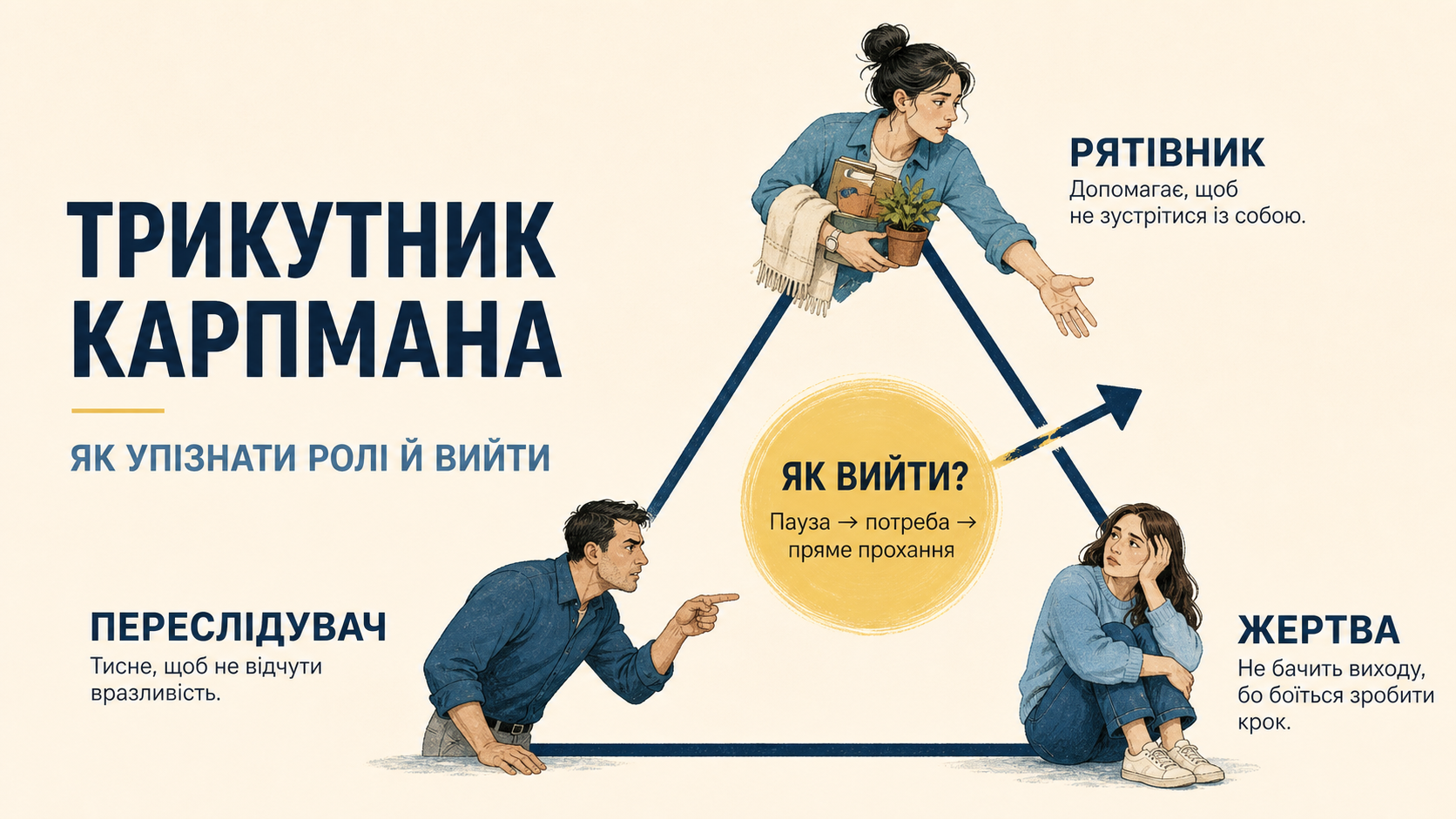
The Karpman Drama Triangle: why good intentions so often end in resentment
One person sighs that everything is on them again. Another rushes in to help. An hour later both are hurt and neither can quite remember how it all started. A familiar scene? In psychology this pattern is called the Karpman Drama Triangle — and it happens more often than loud arguments, which is why people rarely recognize it right away.
People rarely come to me saying, “I’m in the Karpman Drama Triangle.” More often it sounds like: “I carry everything on my shoulders,” “it’s hard for me to say no,” “I feel guilty when I choose myself,” “I put up with things for a long time and then explode over nothing.” The Karpman Drama Triangle is simply a useful language for a pattern that is easy to see in hindsight: Victim, Rescuer, Persecutor. These are not labels for people, but roles we can be pulled into — sometimes several times within one conversation.
In transactional analysis, I look at these situations through contact with the Adult ego state — the part of us that can see facts, boundaries, and real options for action. But inside the triangle we are usually swept away: into an adapted Child who feels powerless and frightened, into a critical Parent who pushes and judges, or into a caring Parent who rescues without being asked. The point is not to judge ourselves for this. The point is to regain choice in places where an automatic script used to take over.
What the Karpman Drama Triangle is
The triangle describes an interaction in which three roles feed one another. The Victim feels powerless or unfairly hurt. The Rescuer steps in to help — often without being asked and at the cost of their own resources. The Persecutor criticizes, shames, pressures, or controls. The tricky part is that these roles are not fixed forever — they can flow into one another within minutes.
Here is an example. A mother reminds her adult son for the third time about unpaid bills. At first she seems to be the Rescuer — she wants him to avoid problems. He gets irritated. Now she feels like the Victim: “I’m not appreciated.” Another minute passes, and she becomes the Persecutor: “You’re irresponsible, I can’t rely on you.” The son also manages to move through all three roles: first he feels small and guilty, then he attacks back, then he comforts his upset mother. The triangle moves — that is exactly why it is hard to catch while it is happening.
In the language of transactional analysis, this resembles a psychological game: a familiar beginning, hidden tension, and a predictable ending after which each person seems to receive confirmation of an old belief about themselves — “people use me,” “nobody needs me,” “there is something wrong with me,” “people cannot be trusted.” That is why the pattern can feel strangely familiar. Almost like home. Even when it hurts.
How to recognize yourself in the roles
The same person can spend time in all three roles throughout life. So the question is not “which one am I?” but “where do I most often get pulled when things become difficult?”
The Victim role
In the Victim role, a person may genuinely be tired, scared, overloaded, and without support — these are real states. The problem begins when powerlessness becomes the only available position, and the inner voice repeats: “I can’t do anything,” “someone has to fix this,” “there is no choice.” In everyday life this can look like complaining without a next step, silently expecting loved ones to guess what is needed, agreeing against oneself — and then feeling resentful immediately afterwards.
Telling yourself to “stop complaining” does not help here; it only adds shame. A question that works better is gentler: what small part of this situation is still within my influence?
The Rescuer role
The Rescuer usually looks like a kind and responsible person — which is why this role is so hard to notice in oneself. Many people learned early that love and safety could be earned by being useful. The Rescuer gives advice when no one asked, does things for others, smooths over other people’s conflicts, lends money they do not really have, answers work messages at ten in the evening. From the outside it looks like, “I just want to help.” Inside there is often fear: if I do not help, I will be rejected, judged, or seen as unnecessary.
You can often hear the difference in the wording. Healthy support asks: “Do you need help, and what kind?” Rescuing states: “I know better, I’ll fix everything now” — and then gets angry that it had to do it again.
The Persecutor role
The Persecutor is not always shouting. Often it is icy silence, sarcasm, moral superiority, endless corrections, pressure disguised as honesty. In this role a person usually feels right: “Someone has to say it like it is.” But the way it is said frightens or humiliates the other person — and contact becomes unsafe for both.
The energy of the Persecutor often appears after prolonged rescuing. A person has said “yes” too many times, ignored their own boundaries — and then suddenly attacks. That is why boundaries are better set before accumulated resentment turns into a weapon.
How the triangle appears in family relationships
In families, the triangle most often forms around care, money, household tasks, and loyalty. “You never help me,” one person says. “I work all day for this family,” the other replies. Someone feels like the Victim, someone feels accused and moves into the Persecutor role, and then someone tries to save the evening by saying, “Fine, I’ll do it myself.” The dishes will be washed. The relationship will not become closer because of it.
Another common storyline is an adult child and their parents. A mother or father gives advice about health, raising grandchildren, or work. The adult child feels controlled and shuts down. The parents feel hurt: “We only wanted what was best.” Both sides may be completely sincere in their feelings — and still end up in roles. Adult communication sounds different here: “I hear that you are worried. Right now I’m not asking for advice. If I need it, I’ll tell you.”
In sessions, I often suggest slowing such a scene down almost frame by frame. We look not only at the words, but also at the hidden transaction: who is really speaking to whom — Adult to Adult? Parent to Child? A frightened Child to a critical Parent inside the person themselves? When a person learns to distinguish a request, a complaint, and an accusation, the triangle has less power.
How the triangle appears at work
At work, the triangle likes to hide behind professionalism. A manager rescues an employee who keeps missing deadlines — and then suddenly snaps into criticism. A colleague takes on extra tasks because negotiating feels harder than simply doing it themselves — and later feels invisible. Someone on the team says, “Nobody explains anything to me,” but never formulates a specific request: who exactly needs to explain what exactly.
Work systems often encourage Rescuers for a while — they are convenient: they stay late, remember other people’s tasks, cover gaps for others. Then the same person burns out or becomes rigid and controlling. Suddenly they are called “difficult,” even though the pattern was supported by everyone who benefited from it.
The Adult position at work is, above all, clarity. Who owns the task? What is the deadline? What exact help is needed? What happens if the agreement is not kept? These questions may seem less warm than emotional rescuing at the ready. But they protect both contact and responsibility at the same time.
How to step out of the Karpman Drama Triangle
The way out usually begins when one person changes their part of the pattern — there is no need to wait until everyone suddenly becomes self-aware and calm at the same time. Small, steady steps really work better here than dramatic promises like “I will never do this again.”
Name the role to yourself — not as an accusation, but as a point of orientation: “I’m starting to rescue,” “I’m falling into helplessness,” “I want to attack.”
Return to the facts. What actually happened? What did we agree on? What do I know for sure, and what am I adding in my mind?
Separate responsibility. What is mine, what belongs to the other person, and what is shared?
Ask directly, not through hints — a clear request gives the other person a chance to respond from their Adult, instead of having to guess.
Help with consent. “Do you need support, advice, or would you simply like me to listen?”
Set boundaries before the explosion builds up. “I’m willing to discuss this for twenty minutes,” “I won’t take on this task today,” “I won’t continue the conversation if there are insults.”
For the Victim, the movement is outward — toward influence: I have options, even if they are small. For the Rescuer, it is toward respect: the other person is capable of carrying their own life. For the Persecutor, it is toward firmness without humiliation: I can be clear without attacking.
If you recognize an old family, work, or couple pattern here, it can be explored in therapy. On the services page I describe formats for individual and couples work, online and offline. A free introductory meeting can help you sense whether this format is right for you.
Frequently asked questions
Does the Victim role mean the person is to blame? No, and this needs to be said clearly. There are very real situations of violence, pressure, injustice, and dependence — the Karpman Drama Triangle is not the point there, and it is certainly not about blaming the person who is hurting. The Victim role describes a position in an interaction where a person loses contact with their influence or is perceived as incapable. Real safety always matters more than any model.
Can I step out of the triangle if others do not change? You do not control the whole system — but you can change your transactions within it: stop rescuing without a request, ask directly, mark boundaries, end conversations where you are humiliated. Sometimes this is enough for the relationship to change too. Sometimes it simply shows that more distance is needed — and that is also an honest outcome.
Why do I keep ending up in the same role? Often because at some point this very role helped a person survive in relationships. A child may have learned to be easy, strong, guilty, invisible, or useful in order to keep a bond with important people. In transactional analysis, we connect this with life script. Understanding where the role came from can remove a lot of shame in itself and make change more realistic.
A calmer way to stay in contact
The Karpman Drama Triangle is useful because it gives language to things many people feel but do not manage to notice in time. It explains why good intentions so often end in resentment, and why a familiar argument can become stronger than common sense.
Stepping out of the triangle does not mean becoming cold or never helping anyone again. It means something else: helping without taking over someone else’s responsibility; asking without devaluing yourself; disagreeing without humiliating. This is the Adult position: I see you, I see myself, and I do not have to play the old game in order to stay in contact.
If you recognize yourself in these examples, it is not a verdict — it is simply information. And patterns that once formed in relationships can also change in relationships: carefully, gradually, and with enough support nearby.

Want to explore what's on your mind?
The first intro meeting is free: 15–20 minutes online to get acquainted and see whether we would be comfortable working together.