 Anna Nuzhna
Transformational psychological games: what they are for
Transformational psychological games: what they are for
You roll the dice, move a piece across the board, draw a card — and suddenly find yourself speaking about something you may have kept silent about for years, even with yourself. A transformational game looks like a board game, and at the same time it is not quite one. Before I explain how it works, I want to clarify the main thing: this is not psychotherapy, and it does not replace the deeper changes that happen in regular therapeutic work. It is a different, softer tool with a different purpose.
What kind of format is this?
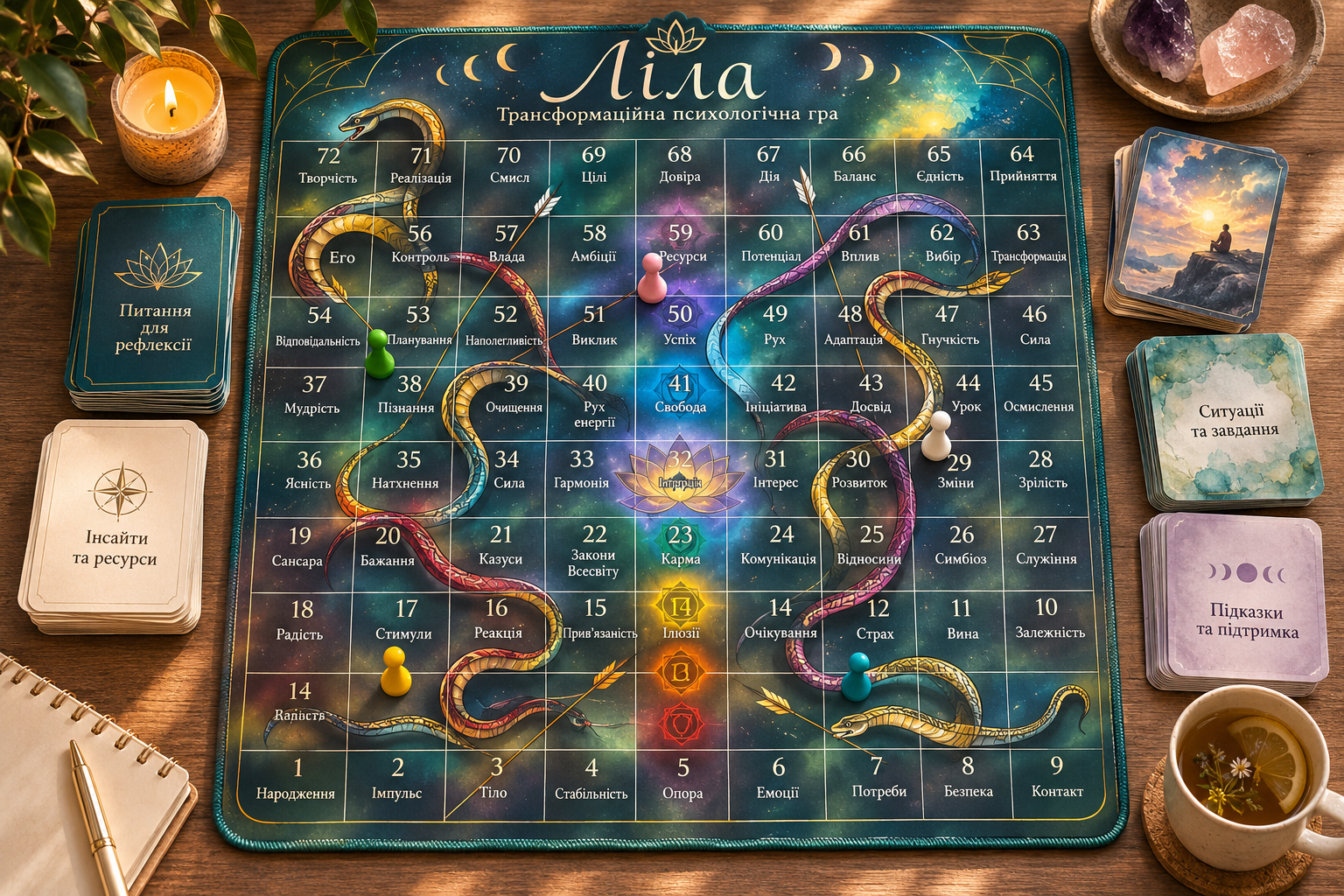
Transformational psychological games such as “Life” and “Leela” are structured like this: you move around a game board, draw cards with questions or situations, and respond to them in the moment, often together with other participants. The flow of the game is not based on “right or wrong”: the aim is not to win. It creates a space where metaphor, symbol and chance can bring to the surface things that are harder to touch in an ordinary conversation.
It is not psychotherapy, and that is okay
A transformational game does not diagnose, treat or replace work with deep patterns, trauma or recurring life scripts. That is what therapy is for, and therapy works differently: regularly, gradually, in long-term contact with one professional. A game is more like an introduction: to yourself, to your reactions, to your psychology in general. It can be a good first step or a complement to therapy you are already in, but it is not a substitute when we are talking about truly deep change.
Why this format works more with the unconscious
In ordinary conversation, we tend to look for the “right”, logical answer straight away, and quite often it is the answer that our conscious mind has already decided is acceptable. A game bypasses this mechanism. When you make a move, draw a card or answer a question within the game, defences soften: it is as if you are talking about a move in the game, not directly about yourself. Paradoxically, this distance brings you closer to something real: a reaction, an image, a word that might have slipped away if you were trying to answer a direct question “properly”.
It is similar to how dreams or drawing can work in therapy: the unconscious rarely speaks in plain language; more often it speaks through symbols, images, unexpected reactions in the body or voice. A game creates conditions where this language has room to appear.
What the game can and cannot give
The game can be useful when a person wants to look at their situation from another angle, notice a pattern they had not seen before, or simply get to know themselves better in a non-clinical, less “serious” format. It offers space for reflection, new questions to ask yourself, and sometimes an unexpected understanding that had been hard to put into words for a long time.
It does not give ready-made answers and does not guarantee a therapeutic result. If the request is deep — long-standing trauma, a stable life pattern, a prolonged anxious or depressed state — the game may become the beginning of a path or a pleasant addition, but it will not replace the work itself, which needs time, regularity and attention to what comes up. And if you are in an acute crisis or need urgent support, this is not the right format: it is better to seek a consultation or psychotherapy directly.
Who it may suit
It may suit people who are interested in psychology but are not yet ready, or do not want, to start therapy. It may suit those who are already in therapy and are looking for a softer, playful way to touch on a topic between sessions. It may suit people who find it easier to speak about difficult things through metaphor rather than directly. And it may suit those who simply want to try a group format for self-exploration together with other people.
How the game takes place
The game can be held individually or in a group, online or in person in Dnipro. We begin by briefly defining the request or theme you are bringing. Then the game itself unfolds according to the rules of the specific format, “Life” or “Leela”. We finish with a discussion: what exactly appeared during the game and how it connects with your real-life situation.
Frequently asked questions
Is the game suitable for someone who has never been in therapy? Yes. It is one of the easiest formats for a first encounter with the psychology of the self, without pressure and without the need to immediately understand something about yourself “correctly”.
Can the game replace psychotherapy? No. The game is an additional tool for self-knowledge, not a replacement for regular work where deep and lasting changes are needed.
Do I need to prepare in advance? No special preparation is needed. It is enough to come with whatever interests or worries you now, even if the wording is still unclear.
Instead of a conclusion
A transformational game is not a replacement for serious inner work, but one way to begin noticing it: gently, without pressure, in a format where the psyche may find it easier to speak than in an ordinary conversation. I like this format because people sometimes tell the truth in it without having planned to do so.
I facilitate the games “Life” and “Leela” personally, individually or in groups, online and in person in Dnipro. You can find the formats and conditions on the services page.

Want to explore what's on your mind?
The first intro meeting is free: 15–20 minutes online to get acquainted and see whether we would be comfortable working together.