 Anna Nuzhna
Couples therapy: what people bring and how it works
Couples therapy: what people bring and how it works
The same argument comes back for the third time this month. The words are different, the ending is the same. I’ve written separately about signs that couples therapy may help a relationship. Here I want to say it more simply: what people actually come with, and what really happens in the room when they get there.
One script, different triggers
Relationships stuck in conflict often look like a dance where both partners keep making the same steps and are surprised each time they step on each other’s feet. “It feels like we speak different languages: I mean care, and he hears blame.” “Every argument ends the same way, even though the reasons are different each time.” “We haven’t really heard each other for a long time, even when we are silent in the same room.” From the inside, this dance is hard to see: both people are too focused on not falling.
What people come to couples therapy with
Communication that turns into an argument. Conversations about money, sex, parenting or boundaries with relatives cannot be held calmly: the topic is either avoided or ends in shouting or silence.
A crisis of trust. An affair, long-term lying, an important decision made behind each other’s backs. It becomes unclear how to move forward: forgive, rebuild or end the relationship.
A major decision ahead. Marriage, a child, a move. The wish is to go through it consciously, rather than by guesswork.
Lost connection. There are almost no arguments anymore, because there are almost no conversations. Daily life, shared tasks and parental roles remain, but the warmth has gone somewhere.
Why it is hard to see this from inside
When a couple tries to resolve a conflict on their own, each person speaks from the position they are already in at the moment of tension: hurt, exhausted, defended. Each sees mainly their own part of the picture. What a couple cannot see in themselves from inside the argument, a therapist often notices within a few sessions, because the focus is not on who is right, but on the structure of the interaction itself: where the conversation breaks down each time, which phrase becomes a trigger.
When it is not only about the relationship
Couples therapy is not the right first step where there is physical violence or a real threat to one partner’s safety. In such situations, the priority is always safety, not joint work on the relationship, and it is worth contacting professionals who specialize in domestic violence.
What to expect from sessions
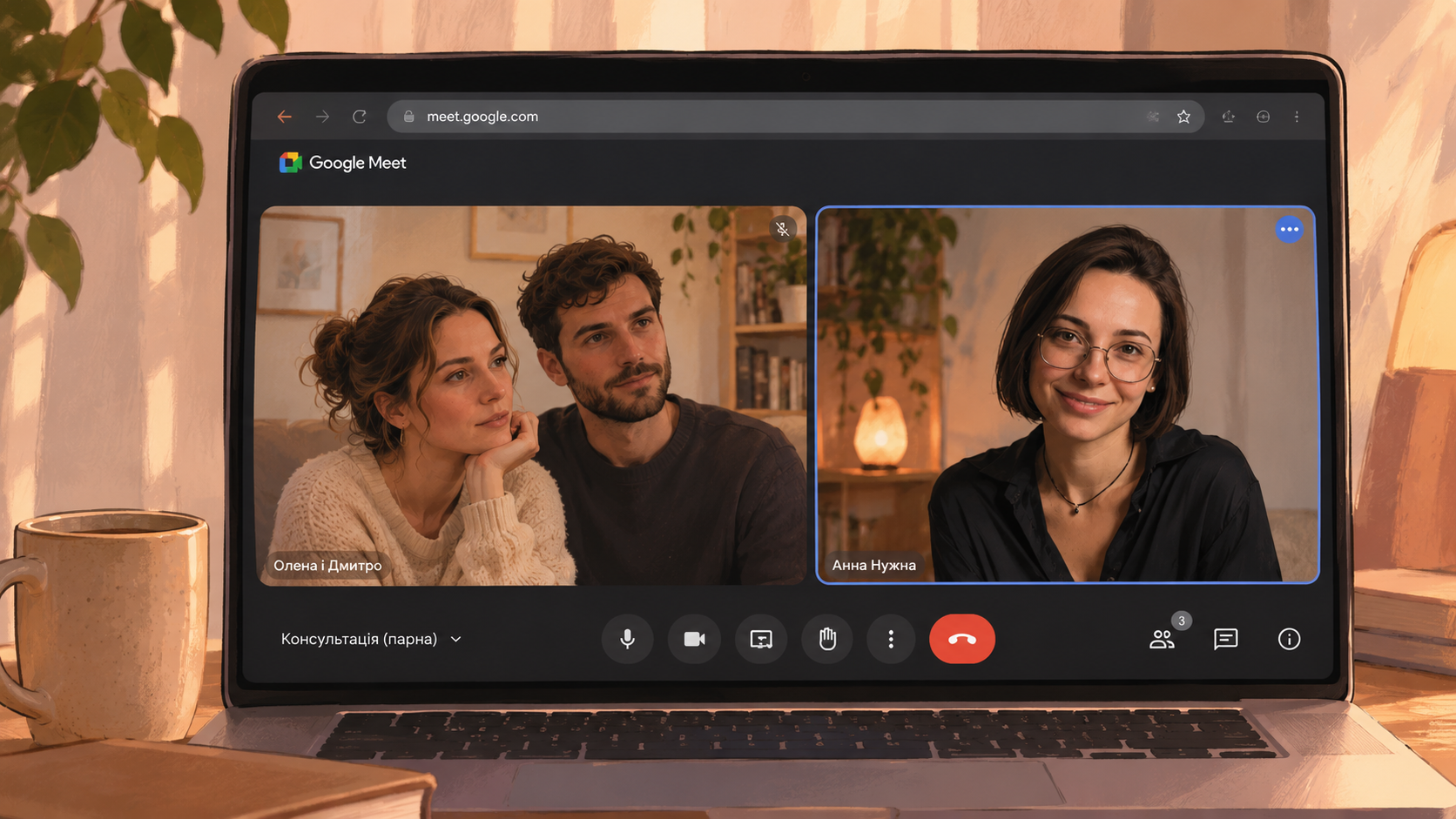
A session lasts 75 minutes and takes place online or in person in Dnipro. The first meetings are usually devoted to understanding the situation: what brought the couple now, what the history of the relationship is, and what they have already tried on their own. Then comes the search for the pattern: what script repeats in conflicts and what role each person has in it. Work with a specific request (communication, trust, preparation for a decision) takes as long as needed, and at the end the couple and therapist check together what has changed and whether it makes sense to continue.
Common questions
Can I come if my partner is not ready yet? You can begin with a conversation about why one of you hesitates. Sometimes one meeting is enough for the second partner to decide to join.
How many sessions are usually needed? It depends on the request. Working with a specific tension in communication may take several meetings, while rebuilding trust or working with deeper patterns may take longer.
Is the goal of couples therapy always to save the relationship? No. The goal is to help the couple make a conscious decision, whatever that decision may be.
Instead of a conclusion
Couples therapy is not about who is to blame for the argument, but about what pattern the couple repeats again and again, and whether it can be changed together. You can read more about the signs that this format may be worth trying in the article “How to understand that couples therapy may help your relationship”.
You can find formats and fees on the services page, and you can start with a free introductory meeting.

Want to explore what's on your mind?
The first intro meeting is free: 15–20 minutes online to get acquainted and see whether we would be comfortable working together.