 Anna Nuzhna
Corporate psychology: support for teams and business
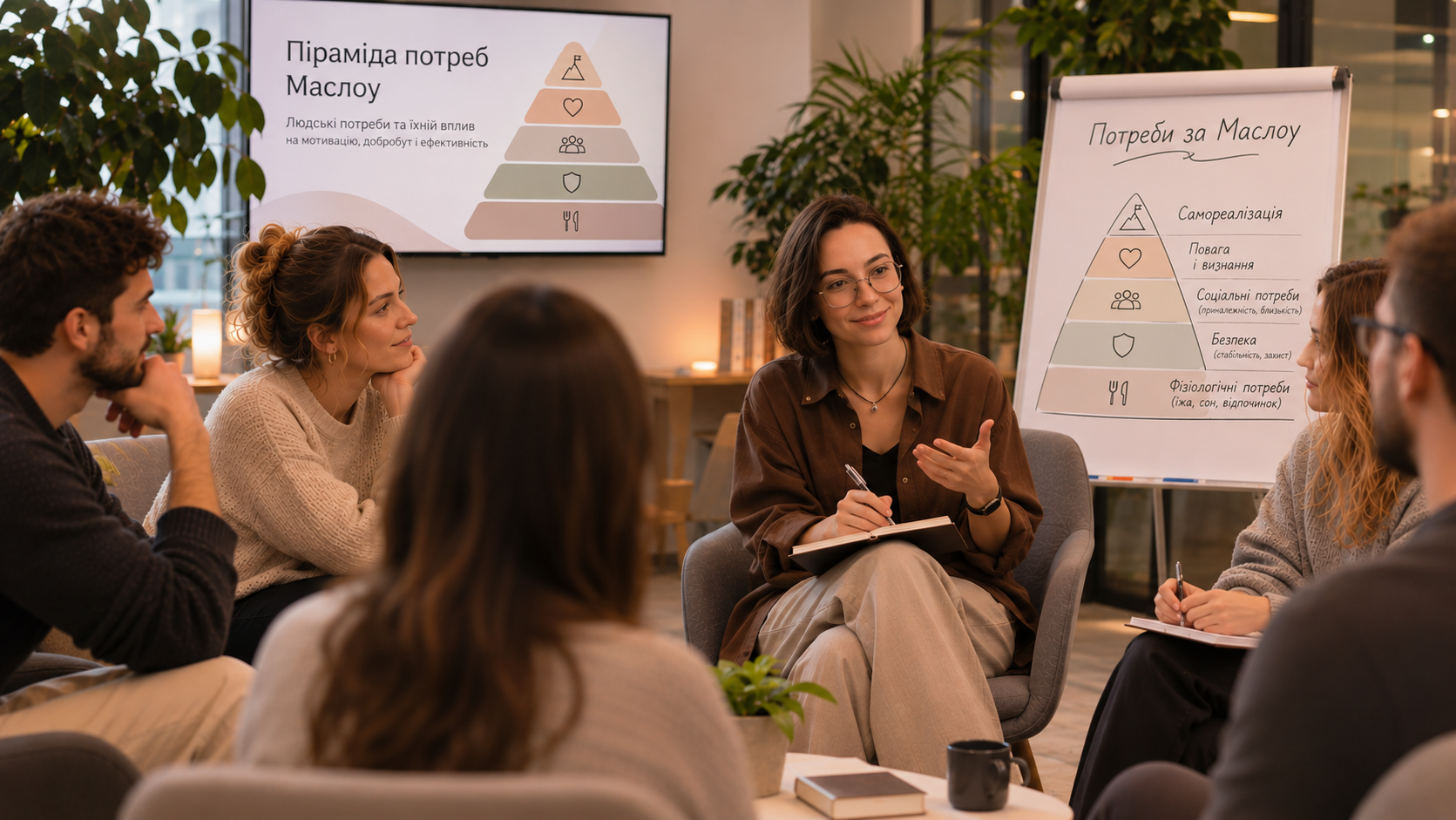
Corporate psychology: support for teams and business
“The team is burned out, and I don’t know how to stop it.” “We avoid difficult conversations, and the tension just keeps building from one meeting to the next.” “Managers carry everything until someone breaks.” Behind these phrases there is usually a request for corporate support: not an abstract “we want something about psychology,” but a very concrete fatigue from what is happening inside the team every day.
The team as a living system
When one organ is working at the edge of exhaustion, the load shifts to all the others, and sooner or later the whole body feels it. A company without psychological safety is like a house without ventilation: from the outside it may look completely fine, while inside it gradually becomes hard to breathe. Corporate psychology works with exactly this: not only with one person’s symptom, but with the air in the room that the whole team breathes.
What corporate psychology includes
One-time formats. Lectures and psychoeducation give the team knowledge and a new angle of view. Trainings and workshops offer a specific skill that can be used in work right away.
Long-term support. Burnout prevention before it becomes chronic. Development of emotional intelligence. Building psychological safety in a team where people can speak openly about problems without fear of punishment. Separate support for managers, who are often responsible for other people’s resilience while also carrying their own load.
Individual therapy for employees. A company can cover a certain number of individual counselling or psychotherapy sessions for employees as part of its care for the team — similar to health insurance, but for psychological wellbeing. This works when group formats are not enough: a person needs their own space for their own situation, not a lecture for everyone. The employer sees only the fact that sessions were used and their number, not their content: everything discussed in the meeting stays between the employee and me.
Game-based and group formats. Transformational psychological games (“Life”, “Leela”) can be used as an alternative to a usual team-building activity: in a playful, less tense form, the team gets space for more honest conversations than during a meeting or a training, and team dynamics often become more visible than in any presentation. Mastermind groups are a regular format for managers or teams where participants bring real work challenges one by one and receive feedback from each other, facilitated by a psychologist. This builds not only separate skills, but also mutual support inside the team.
Why this is good for business, not only for people
A burned-out team works worse, and this may not be visible immediately, but it shows up in quarterly numbers: more sick leave, higher turnover, vacancies taking longer to close, more time spent settling conflicts instead of doing the work. A team with psychological safety recognises and corrects mistakes faster instead of spending time hiding them. Investment in the team’s state usually does not return instantly, but it is more stable than it may seem at the beginning.
When companies usually reach out
The request rarely appears “just because” — there is usually a specific moment behind it: after a conflict or crisis in the team, during reorganisation or layoffs, when sick leave and turnover noticeably increase, during rapid growth when culture and onboarding processes cannot keep up with the number of new people. There is also another scenario: a company reaches out not during a crisis, but for regular prevention, much like a routine health check, without waiting until something already hurts.
Who this service is for
Companies and teams of any size, HR departments, managers, educational institutions and communities that want to support people’s psychological state systematically, rather than reacting only when a problem has already turned into a crisis.
How the cooperation works
Everything starts with a request and a short conversation about what is concerning the company and what goal it wants to reach. Then we choose the format: a one-time lecture, a series of trainings, or long-term support for a team or a manager. The work can take place online or offline, in Dnipro or remotely for teams in any location. At the end, we summarise the result and, if needed, discuss the next steps.
The topic and format are always selected for the company’s specific request, not offered as one standard package.
Frequently asked questions
How much does a corporate programme cost? The price depends on the format, the number of participants and the duration of the cooperation, so it is discussed individually after the first conversation.
Can we book a one-time lecture instead of a long-term programme? Yes, the company chooses the format: it can be a one-time event or regular support, depending on the request.
Will the employer know what an employee talked about in individual sessions? No. Confidentiality works the same way as in any other therapy: the company sees only that the service was used, while the content of the conversations stays between the employee and me.
Do you work with teams that are currently under stress because of crisis or war? Yes, this has been one of the common requests recently, and the support format is chosen with the current state of the team in mind.
Instead of a conclusion
The state of a team directly affects business results. Corporate psychology is a way to support this state systematically, not only when a problem has already become a crisis.
You can learn more about formats and cooperation terms on the services page — and leave a request there for a free conversation about your company’s needs.

Want to explore what's on your mind?
The first intro meeting is free: 15–20 minutes online to get acquainted and see whether we would be comfortable working together.